
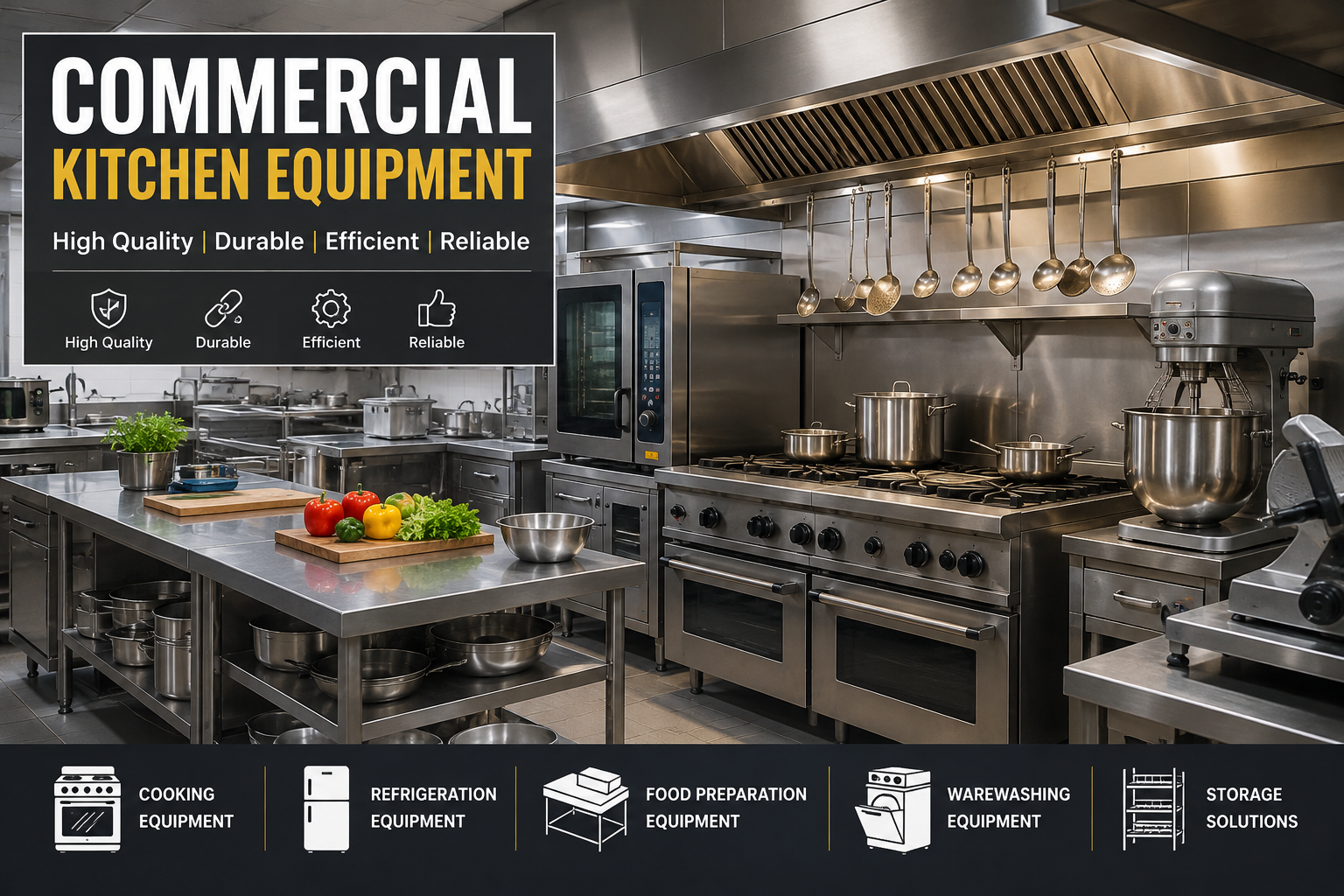
Setting up a restaurant kitchen is an important part of starting a food business. The right commercial kitchen equipment can make cooking easier, improve the speed of service, and help your staff work more comfortably. On the other hand, choosing equipment without understanding your actual requirements can lead to wasted space, higher expenses, and unnecessary maintenance.
Every restaurant has different needs. A small café does not require the same setup as a large hotel kitchen, and a bakery will need different machines from an Indian restaurant. This is why equipment should always be selected according to your menu, kitchen size, daily workload, and budget.
Start With Your Menu
Your menu should be the first thing you consider when planning your kitchen equipment.
Think about how every dish is prepared. If your restaurant serves fried food, you may need a commercial fryer. If you prepare curries and gravies in large quantities, heavy-duty cooking ranges and preparation equipment will be important. A bakery may need ovens, dough mixers, and planetary mixers.
Making an equipment list based on your menu helps you avoid buying machines that you may rarely use.
Consider the Size of Your Kitchen
Kitchen space can quickly become crowded when equipment is not planned properly. Before purchasing anything, measure the available area and decide where each machine, worktable, refrigerator, and storage unit will be placed.
There should be enough room for chefs and kitchen staff to move safely. Equipment should also be positioned so that frequently used items are easy to reach.
A well-planned layout can save time during busy hours because staff do not have to move unnecessarily from one side of the kitchen to another.
Think About Your Daily Workload
The amount of food you prepare each day should influence the capacity of your equipment.
For example, a small restaurant serving a limited number of customers may work comfortably with a compact refrigerator and medium-capacity cooking equipment. A busy restaurant serving hundreds of meals each day will need equipment designed for continuous and heavy use.
Always consider your busiest service period. Equipment that works well during a quiet afternoon may not be enough during a busy lunch or dinner service.
Choose Durable Equipment
Restaurant kitchens are demanding environments. Cooking equipment can be used for many hours every day, so durability should be an important consideration.
Look for equipment made from strong, easy-to-clean materials. Stainless steel is widely used in commercial kitchens because it is durable, practical, and suitable for regular cleaning.
Do not focus only on the appearance of a machine. Check its construction, components, capacity, and suitability for your workload before making a purchase.
Check Energy Requirements
Commercial kitchen equipment can consume a considerable amount of electricity or gas. Before buying, check the power or fuel requirements of each machine.
You should also make sure your kitchen has the necessary electrical connections, gas lines, water supply, drainage, and ventilation.
Energy-efficient equipment may cost more initially, but lower operating costs can make it a worthwhile investment over time.
Make Cleaning Easy
Cleaning is a major part of restaurant kitchen work. Equipment that is difficult to clean can take more time and may become a problem during busy operations.
Choose machines with simple designs, accessible parts, and smooth surfaces wherever possible. Worktables, counters, cooking equipment, and storage units should be easy for staff to clean regularly.
Easy maintenance also helps keep the kitchen organized and reduces the chances of equipment developing problems because of poor cleaning.
Pay Attention to Refrigeration
Refrigeration is essential for storing vegetables, dairy products, meat, seafood, sauces, and other ingredients.
Choose a refrigerator or freezer according to the amount and type of food you need to store. Consider the storage capacity, temperature control, energy use, door arrangement, and available kitchen space.
It is better to choose a suitable size based on your actual inventory rather than buying a unit that takes up valuable kitchen space without being fully used.
Plan for Food Preparation
Food preparation can take up a large part of the working day. The right preparation equipment can help kitchen staff complete repetitive tasks more quickly.
Depending on your menu, you may require mixer grinders, food processors, vegetable cutters, dough kneaders, meat mincers, or other specialized machines.
For restaurants preparing large quantities of food, suitable preparation equipment can reduce manual work and help maintain consistency.
Don't Forget Ventilation
A commercial kitchen produces heat, smoke, steam, and cooking odors. A proper exhaust and ventilation system is therefore an essential part of the kitchen setup.
The ventilation system should be planned according to your cooking equipment and kitchen layout. Cooking ranges, fryers, grills, and other heat-producing equipment may require suitable exhaust arrangements.
Good ventilation makes the working environment more comfortable and helps manage heat and smoke during service.
Consider Your Budget
Your budget should include more than the purchase price of the equipment.
Think about installation, electricity or gas consumption, maintenance, spare parts, and possible repairs. A cheaper machine may not always be the better choice if it requires frequent servicing or has a short working life.
Instead of trying to buy everything at the lowest price, focus on getting reliable equipment that offers good value over the long term.
Check After-Sales Service
Commercial kitchen equipment is a long-term investment, so service support matters.
Before purchasing, ask about warranty coverage, spare parts, installation, maintenance, and repair services. A supplier with dependable support can be especially valuable when a machine stops working during busy restaurant hours.
Good after-sales service can reduce downtime and help keep your kitchen running without major interruptions.
Choose Equipment That Fits Your Workflow
The best kitchen is not simply the one with the most equipment. It is the one where everything works together efficiently.
Try to organize the kitchen in a logical sequence:
Storage → Preparation → Cooking → Plating → Serving → Washing
Keeping related equipment close to each other can reduce unnecessary movement and make work easier for kitchen staff.
For example, preparation tables should be close to the areas where ingredients are stored and cooked. Washing equipment should also be positioned in a way that keeps dirty utensils away from food preparation areas.
Final Thoughts
Choosing the right commercial kitchen equipment for your restaurant requires careful planning. Start with your menu, understand your expected workload, measure your kitchen space, and consider durability, energy use, cleaning, maintenance, and service support.
You do not need to buy every type of equipment available in the market. Focus on the machines that your restaurant actually needs and choose their size and capacity according to your daily operations.